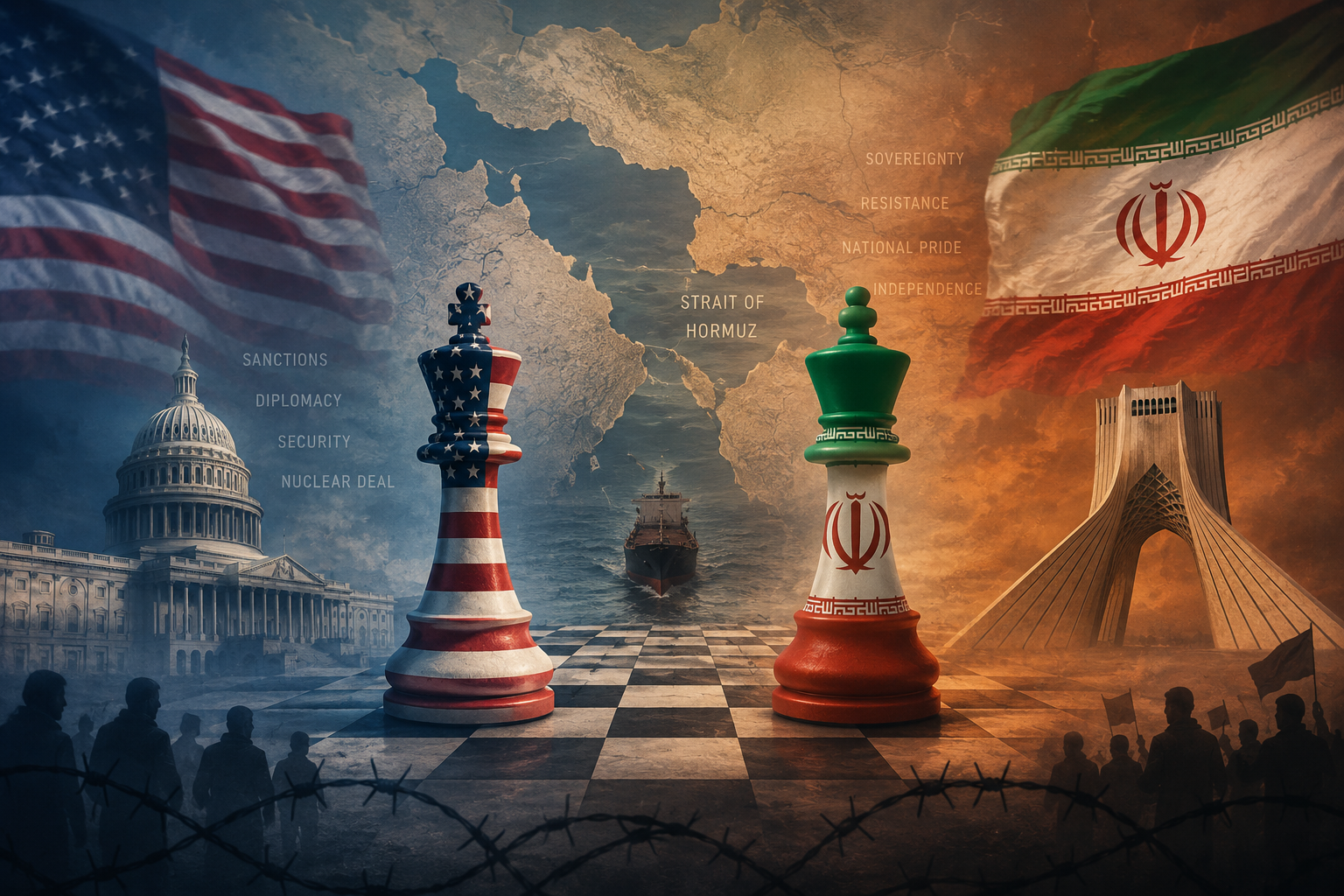
Iran and America: A Relationship Built on Fear and Mistrust
The relationship between Washington and Tehran has never been only a matter of foreign policy. It is not only about nuclear agreements, sanctions, oil routes, military bases, or diplomatic meetings. It is also a relationship shaped by memory, pride, fear, humiliation, and the everyday lives of ordinary people. When the United States and Iran speak to each other, they do not speak only as two governments. They speak as two political worlds carrying old wounds and new anxieties.
Recent newspaper reports show that the situation between Iran and the United States has again become tense and uncertain. Reuters reported that renewed confrontation around the Strait of Hormuz has placed the fragile US-Iran ceasefire under pressure, while AP’s report on fresh US strikes against Iran noted that new attacks have raised serious questions about whether diplomacy can survive another round of military escalation. The Guardian also reported that the breakdown of the truce has increased fears of a wider regional crisis.
But to understand this relationship properly, we need to look beyond the headlines. We need to ask why both sides return again and again to the same cycle: threat, negotiation, mistrust, sanctions, military pressure, and then another attempt at dialogue. This cycle has become almost familiar. It has become part of the political culture of both countries.
For Washington, Iran is often presented as a security threat. It is discussed through the language of nuclear risk, regional militias, missile power, and danger to US allies. For Tehran, the United States is often presented as an arrogant outside power that wants to control Iran’s choices, weaken its independence, and punish its people through sanctions. These two stories are deeply different, but both are powerful. They give each government a moral language. Each side tells its people that it is acting for survival, dignity, and national protection.
This is why diplomacy is so difficult. Diplomacy requires more than signing documents. It requires both sides to recognize each other as legitimate political actors. Yet recognition has always been weak in US-Iran relations. Washington often sees Tehran as a problem to be managed. Tehran often sees Washington as a force that cannot be trusted. In such a situation, a negotiation table becomes fragile. One speech, one airstrike, one ship attack, or one sanction can destroy months of talks.
The Strait of Hormuz has now become one of the strongest symbols of this conflict. Reuters described how Iran increasingly views the strait as a powerful source of leverage because a large share of global energy trade passes through this narrow waterway. For the United States and its allies, keeping the route open is a matter of global trade and security. For Iran, influence over the strait is also a way of saying: “You cannot isolate us and still expect the world to move normally.”
This is where geography becomes political. A waterway is not only water. It becomes a symbol of pride, pressure, fear, and bargaining power. The Strait of Hormuz is a place where local geography meets global anxiety. Ships, oil prices, naval patrols, and military warnings all become part of a larger drama of power.
The nuclear issue has also become more than a technical dispute. The 2015 Iran nuclear deal, known as the JCPOA, was designed to limit Iran’s nuclear programme in exchange for sanctions relief. The agreement involved Iran, the United States, China, Russia, France, Britain, Germany, and the European Union. When the United States withdrew from the deal in 2018 under President Donald Trump, it deepened Iranian distrust of American promises. Reuters reported at the time that Trump called the deal defective and announced the US withdrawal.
For many Iranians, the withdrawal was not just a policy change. It became another memory of betrayal. For many Americans, Iran’s later nuclear steps became proof that Tehran could not be trusted without pressure. This is how mistrust becomes historical. Each side uses the past to explain why the other side is dangerous.
History matters strongly here. Iran still carries the memory of foreign interference, including the 1953 overthrow of Prime Minister Mohammad Mosaddegh, an event that remains central to Iranian nationalist memory. The Council on Foreign Relations notes that the 1953 coup helped fuel anti-American feeling in Iran. The United States, on the other hand, carries the memory of the 1979 hostage crisis, when American embassy staff were held in Tehran after the Islamic Revolution. These memories are not dead history. They are alive in speeches, school lessons, media narratives, political slogans, and public emotions.
This is why the conflict is not simply strategic. It is emotional. Nations also remember. Nations also feel insulted. Nations also construct enemies. Leaders use these feelings to build unity at home. When a government says, “We are resisting foreign domination,” it creates one kind of national emotion. When another government says, “We are defending the world from danger,” it creates another kind of national emotion. Both narratives make compromise harder because compromise can look like weakness.
Sanctions show the human side of this conflict most clearly. In diplomatic language, sanctions are called pressure. But in ordinary life, pressure has another meaning. It means higher prices, weaker currency, fewer imported goods, medicine shortages, job insecurity, and uncertainty about the future. The US Treasury continues to list recent Iran-related sanctions actions, showing that sanctions remain a central tool of American policy.
Studies on Iran’s economy show that sanctions have affected exchange rates, inflation, output growth, employment, labour force participation, and education, with stronger effects on women in some areas. Research on Iran’s medicine supply has also shown that sanctions and financial restrictions have disrupted access to timely medical care. The Stimson Center reported in 2025 that inflation and medicine shortages had made treatment increasingly difficult for many Iranians.
This is where the story becomes deeply human. A sanction announced in Washington may appear as a legal measure. In Tehran, Shiraz, Isfahan, or Mashhad, it may appear as a father unable to afford medicine, a student unable to pay tuition abroad, a shopkeeper unable to import goods, or a mother cutting household expenses. What looks like foreign policy on television becomes the price of bread, medicine, transport, and hope.
War also enters everyday life before bombs fall. People begin to calculate risk. They ask whether prices will rise. They wonder whether fuel will be available. They follow the news more anxiously. Families discuss whether someone should migrate. Students wonder if their future will close before it begins. Traders wait before making investments. Parents save money in different ways. Fear becomes part of daily planning.
This is one of the most important but least discussed sides of US-Iran relations. Ordinary people are not simply spectators. They are the ones who absorb the consequences of elite decisions. Presidents, generals, diplomats, and negotiators speak the language of national interest. Ordinary citizens live the language of survival.
There is also a strong performance of masculinity in this conflict. Leaders on both sides often feel pressure to appear strong. They cannot look afraid. They cannot look soft. They cannot easily say, “We miscalculated.” Public politics rewards hard language. Threats become a form of performance. Military action becomes a way to show resolve. Resistance becomes a way to show dignity.
This pattern is dangerous because it leaves little room for quiet compromise. If a leader builds his image on toughness, then negotiation can look like surrender. If a state builds its identity on resistance, then concession can look like betrayal. As a result, diplomacy becomes trapped. Leaders may know that war is costly, but they also fear the political cost of appearing weak.
Media plays a major role in keeping this cycle alive. Newspapers and television channels do not simply report events. They also shape how people understand them. A headline can make one side look aggressive and the other defensive. A word like “retaliation” suggests justice. A word like “attack” suggests aggression. A word like “pressure” sounds strategic. A word like “punishment” sounds cruel. The same event can have different meanings depending on who is telling the story.
This does not mean all narratives are equal or that facts do not matter. Facts matter deeply. But facts reach people through language, images, memory, and emotion. A missile, a sanction, a speech, or a diplomatic meeting becomes meaningful only when people place it inside a story. Washington and Tehran have been telling hostile stories about each other for decades.
Digital life has also become part of the conflict. Recent research on Iran’s internet shutdowns found that disruptions in 2026 were large-scale and centrally coordinated, affecting access to information and communication. Internet restrictions are not separate from geopolitics. They shape how people speak, organize, learn, protest, and stay connected with relatives abroad. In times of crisis, controlling information becomes another form of power.
For young Iranians, this matters deeply. Their lives are shaped not only by local politics but also by global restrictions. Sanctions affect banking, travel, education, technology, and work. Internet controls affect speech, learning, and connection. War threats affect dreams of stability. A young person growing up under permanent crisis may learn to live with uncertainty as a normal condition.
This is why the Iran-America conflict should not be understood only as a clash between two governments. It is also a struggle over futures. What kind of future can Iranian youth imagine? What kind of Middle East does Washington imagine? What kind of security do Gulf states want? What kind of world order allows one state to sanction another while still claiming moral authority? These questions are not only political. They are social and ethical.
The tragedy is that both war and diplomacy have become familiar scripts. War is presented as necessary pressure. Diplomacy is presented as possible but unreliable. Each side enters negotiations while preparing for failure. Each side says it wants peace but acts as if conflict may be unavoidable. This creates a permanent half-war, half-diplomacy condition.
In this condition, no one fully wins. Iran suffers economic and social pressure. The United States carries the burden of endless involvement in the Middle East. Gulf countries live with security anxiety. Global markets fear oil shocks. Ordinary people across the region live under uncertainty. Even when full war is avoided, peace does not truly arrive.
A better path would require a different kind of thinking. The question should not only be: How can Iran be pressured? Or how can America be resisted? The deeper question should be: What kind of relationship can reduce fear without humiliating either side? Durable peace cannot be built on humiliation. A state that feels humiliated may accept a deal temporarily, but resentment will remain. A state that feels insecure may sign an agreement, but suspicion will remain.
This does not mean ignoring real security concerns. Iran’s nuclear programme, regional influence, and military activities are serious issues. American military pressure, sanctions, and interventionist history are also serious issues. A serious discussion must hold both truths together. Peace requires accountability, but it also requires dignity.
Washington and Tehran are trapped because each side has made the other part of its political identity. Iran’s revolutionary politics has often used resistance to America as a symbol of independence. American policy has often used pressure on Iran as a symbol of toughness in the Middle East. These identities are useful for politics, but harmful for people.
The real cost of this relationship is not measured only in military budgets or oil prices. It is measured in postponed dreams, expensive medicine, anxious families, restricted movement, broken trust, and generations raised under the shadow of conflict. The world often sees Iran and America through maps, missiles, sanctions lists, and diplomatic statements. But the deeper story is about human beings living inside the decisions of powerful states.
Washington and Tehran may continue to speak in the language of war and diplomacy. But the future will depend on whether they can learn another language: one of historical honesty, political restraint, mutual recognition, and concern for ordinary lives. Until then, every ceasefire will remain fragile, every negotiation will carry old suspicion, and every promise of peace will stand too close to the possibility of another war.
This article is part of my broader interest in human-centered political analysis, where global conflicts are discussed through people’s lives, historical memory, fear, identity, and the everyday consequences of power. As an Anthropology graduate, I try to look beyond official statements and examine how international politics affects ordinary people, families, communities, and future generations. For collaboration, research support, or writing-related work, feel free to contact me here.

Leave a Reply